--Nathaniel Branden (1930-2014) Psychotherapist and author.
Above: Twin Tunnels, Blue Ridge Parkway, Mile 344.5 (between Crabtree Falls and Mt. Mitchell).


 To maintain a joyful family requires much
from both the parents and the children. Each member of the family has to
become, in a special way, the servant of the others.
To maintain a joyful family requires much
from both the parents and the children. Each member of the family has to
become, in a special way, the servant of the others. 


 It's better than I ever imagined it would be -- I know it's going to get a lot of use. People are really going to love having a long flat, largely uninterrupted trail for biking, jogging and walking. I see lots of smiles and hear lots of "This is amazing" comments from the people I've passed on the trail. I'm impressed with the thoughtful planning and the quality of the work that has gone into this project. If you'd like to take part in the inaugural event, click the link above to sign up and register. Click here to like the Facebook Page.
 |

 This home, built in 1784 by Colonel John Tipton (1730–1813), is part of the Tipton-Haynes Historic Site in Johnson City, TN. Click here to read more about the house and its colorful history.

 The replica cabin (above) and the small monument (left) are found at the Davy Crockett Birthplace in Limestone, TN. Now a state park, the birthplace occupies over 100 acres along the Nolichucky River in Greene County, TN. A museum and outdoor displays tell the fascinating story of this legendary frontiersman. The fifth of nine children born on the frontier years before Tennessee was a state, Crockett would one day represent Tennessee in Congress and die at the Battle of the Alamo at age 49. Here's The Ballad of Davy Crockett ... which is pretty much what everyone thinks of when they hear his name.


 Founded in the 1770s, the St. John Milling Company of Watauga, TN was the longest continuously operating business in Tennessee until it closed its doors last year. Remarkably, it stayed in the same family during its long history. It began with Jeremiah Dungan purchasing 400 acres of land and building a mill powered by a 16 foot water wheel on Brush Creek. The stone manor located across the road was also built at that time. It wasn't until the 1930s that the mill would be powered by electricity. Click here for an article with additional information about the mill's history.

 Here, alone atop Iron Mountain, lies Uncle Nick Grindstaff, born December 26, 1851 and died July 22, 1923. For forty years he lived alone on this ridge between Stoney Creek and Doe Valley, on the border of Carter and Johnson Counties. It's not exactly known what led him to become a hermit. The story of his life seems shrouded in mystery. Orphaned as a small child, he was raised by relatives and had the reputation of being a smart, hard working, "model" young man. When he became an adult, he inherited the family farm and made a go of it for a few years but eventually sold it and headed out west to Missouri. It's not exactly clear what led him there or what really happened. Some say he married and his young bride soon died. Others say his love married another. Still another account said he was beaten and robbed and stripped of everything he had. Whatever befell him, Nick never recovered. He moved back to east Tennessee and for the next forty years lived as a hermit on Iron Mountain. Twice a year he would come down to the local general store for meal, bacon and other supplies... and to get a haircut. His only companions on the mountain were his dog "Panter", a cow he used as a pack animal, and his pet rattlesnake (!).
 In July 1923, a friend, Baxter McEwen, stopped by his shack to check in on him and found him dead. Legend has it that Panter was so protective he wouldn't let anyone remove the body. Eventually, Nick was given a Christian burial with family and friends in
attendance. At some point, Panter was also buried there. Though he isolated himself, he must have been loved -- for two years later, they returned to construct and dedicate the
chimney-shaped monument you see above. It was the shopkeeper who penned Nick's sad epitaph:
In July 1923, a friend, Baxter McEwen, stopped by his shack to check in on him and found him dead. Legend has it that Panter was so protective he wouldn't let anyone remove the body. Eventually, Nick was given a Christian burial with family and friends in
attendance. At some point, Panter was also buried there. Though he isolated himself, he must have been loved -- for two years later, they returned to construct and dedicate the
chimney-shaped monument you see above. It was the shopkeeper who penned Nick's sad epitaph: But the legend and mystery did not stop with his death. It's said that years later, Appalachian Trail hikers who camped near the grave reported hearing the mournful, haunting howls of a dog in the night.


 Directions: Take Route 19E to the town of Roan Mountain, turn
onto Route 143 and travel 12.8 miles to the TN/NC state line (Carver's
Gap). On your way up the mountain, you'll pass through the Roan Mountain State Park.
Eventually, you leave the state park and enter the national forest. Option 1:
Park at Carver's Gap and take the AT approx. 1.5 miles up (heading south
on the AT, away from the Balds). I really like this section of the AT. It's beautiful and, while a steady climb, not as steep as you might think. -- Option 2: Turn right at Carver's Gap and
continue driving up the mountain to the Old Cloudland Hotel Site (this road is closed
during the winter months). Pay the entrance fee ($3) and park at the end of the lot nearest the bathrooms, look for and climb a short flight of stairs and venture to your left. You'll soon run into the AT. Turn right to hike north on the AT (toward the balds) for a
short distance (approx. 1/2 mile) -- on the way you'll pass by an old chimney. The shelter is located one tenth of a
mile off the AT on well-marked, blue-blazed trail. Click here for the Google map of the Roan Mountain area.
Directions: Take Route 19E to the town of Roan Mountain, turn
onto Route 143 and travel 12.8 miles to the TN/NC state line (Carver's
Gap). On your way up the mountain, you'll pass through the Roan Mountain State Park.
Eventually, you leave the state park and enter the national forest. Option 1:
Park at Carver's Gap and take the AT approx. 1.5 miles up (heading south
on the AT, away from the Balds). I really like this section of the AT. It's beautiful and, while a steady climb, not as steep as you might think. -- Option 2: Turn right at Carver's Gap and
continue driving up the mountain to the Old Cloudland Hotel Site (this road is closed
during the winter months). Pay the entrance fee ($3) and park at the end of the lot nearest the bathrooms, look for and climb a short flight of stairs and venture to your left. You'll soon run into the AT. Turn right to hike north on the AT (toward the balds) for a
short distance (approx. 1/2 mile) -- on the way you'll pass by an old chimney. The shelter is located one tenth of a
mile off the AT on well-marked, blue-blazed trail. Click here for the Google map of the Roan Mountain area.

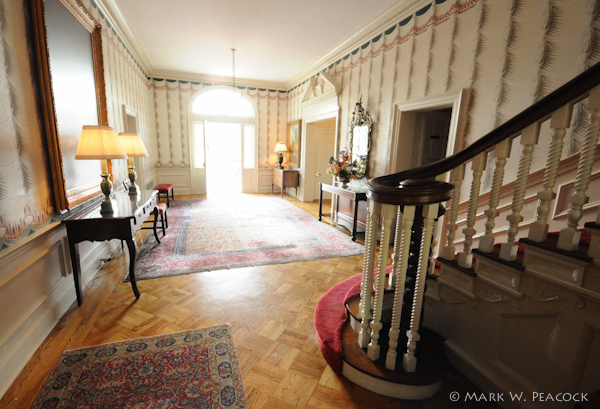
 Click on the thumbnail photos to enlarge. The first is of the entryway, the impressive staircase (the second image) and the exterior columns and portico were bought by Mr. and Mrs. Brooks in Knoxville and shipped to the building site. The third image is of the pink room (Bride's Bedroom) on the second floor.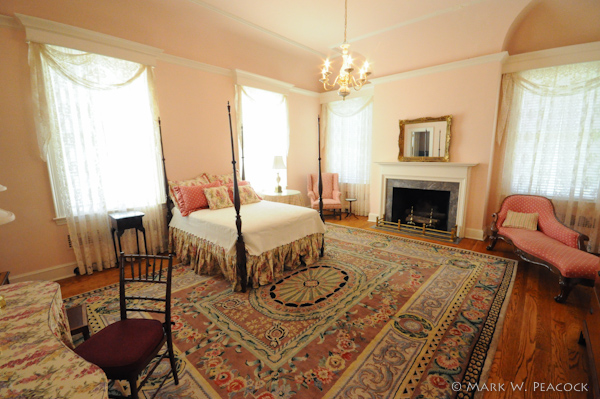

 Jacob Brown, born in Virginia in 1736, moved to the Nolichucky area of what was then North Carolina territory in 1754 on land leased from the Cherokees. He established a trading company and provided blacksmith and gunsmith services. His home was located just three miles from Col. John Sevier's home -- who he followed into battle at Kings Mountain as part of the Overmountain Men. He was a captain at the time of the Battle of Kings Mountain, and was later promoted to second Major of the Washington County militia when it was part of the short-lived State of Franklin. Brown died in a hunting accident in 1785. The large monument you see here incorporates the original small stone (click photo to enlarge). The Brown Cemetery is said to be the oldest marked cemetery in Tennessee and is located next to the Nolichucky River in a remote area of Washington Co, TN. More on Jacob Brown and his family here. Click here for directions to the cemetery and a listing of those interred there.


After county officials were unable to find a bridge contractor, a local doctor, E.E. Hunter, accepted the contract and hired experienced people to work on the bridge. Hunter selected Thomas Matson, who had been an engineer for the Narrow Gauge (Tweetsie) Railroad as an engineer and architect. Hunter referred to the bridge as his "$5 bridge" since he made a profit of $5 as contractor.... Structurally, the bridge contains one span, a covered wooden Howe Truss that is 137 feet long. The total length is 154.3 feet. The bridge contains one traffic lane and a single walkway.Give the gift of Appy Treks this Christmas -- 2011 Calendar on sale here! :)

 Washington College Academy was established in 1780 by Dr. Samuel Doak, a Presbyterian minister, educator and abolitionist. At the time of its founding "in the wilderness" (basically anywhere west of the Appalachians) Tennessee was not yet a state (that wouldn't occur until 1796), so the school's initial charter was granted by the state of North Carolina. Called Martin Academy at the time, it was the first institution of higher education west of the Appalachians. In 1795, the name was changed in honor of our first President, becoming the first educational institution in the US to bear his name. Known for its 'classical education', Washington College boasts a number of notable graduates including three governors, numerous legislators, and many college presidents, ministers, teachers, judges and lawyers. In 1923, the college curriculum was dropped and the institution became a college preparatory school. In recent years, the Academy has fallen on hard times and no longer operates as a college preparatory boarding school. It does, however, continue to offer a number of continuing adult education and GED classes. The 120 acre campus, located 7 miles southwest of Jonesborough, TN, is beautiful and loaded with history. Directions here. For more information, click here and here.
 This eleven story building in downtown Johnson City, TN was known as the John Sevier Hotel when it opened in 1924. It adopted its current name, the John Sevier Center, when it was renovated in 1979 and turned into subsidized housing for the elderly. There are two things the Sevier Center is known for: First, it was one of the places Al Capone stayed in Johnson City on his trips to Florida. His visits to the "Appalachian Wing" of his bootlegging operations were so frequent that Johnson City earned the nickname "Little Chicago" (more here); and Second, this was the site of Johnson City's worst tragedy when shortly after 5 p.m. on Christmas Eve, 1989 the building was ignited by careless smoking. It took firefighters six hours to contain the blaze which took the lives of 16 residents and injured 51 others, including 25 firefighters. More on the tragic fire here and here. In case you're wondering who John Sevier was, click here and here.